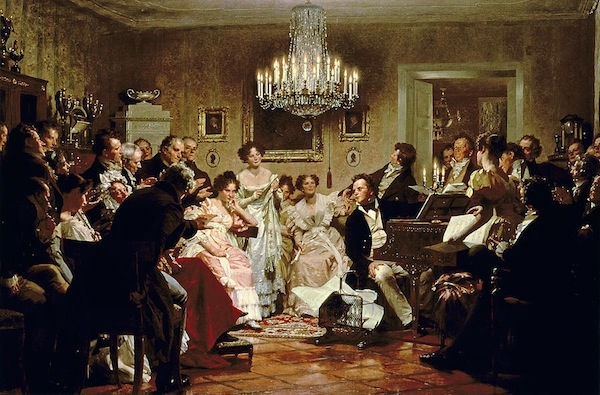
I Love Him, He Loves Me Not: Reimagining Schubert's Queerness.

Poem of Research for Lyrical Inspiration
Why doesn’t he love me?
What is wrong with me?
Am I ugly?
or fat?
Does he think
that our children
won’t turn out?
Is he scared of commitment?
or Am I just unlovable?
I wish I could marry.
he says
"he wish he could marry,
but marriage
is a terrifying thought
for a free-lance musician
such as himself
because he must apply
to the authorities
for simply permission to wed,
and inasmuch
as he cannot
demonstrate
that he
can support a family,
he must renounce his deepest desire
and plunge instead either
into melancholy
or sensual excess"
Was Schubert Queer?
and I wonder,
is it really only a matter of money?
Or is it more about desire
not only to his music
but to his involvements
people speak of
his involvement
in all male activities and associations
we've all heard the rumors that Schubert loved women
a certain kind of woman
at these all men events
but others say
"it is the softness, the yielding, the gushing, the acting according to whims which does not know of self-deprivation, or of the overcoming of obstacles, or of obedience…" which hold him back from familial success
they say it is his
"raging enjoyment of life"
but are these the people?
the only one's who can live
uncrippled by commitment
by family ideals
forced to a life of privacy
but worth it for a chance at success
the signs and possibilities
point to ideas that
maybe he preferred a man's company
A message from the people:
how dare you
he worships many women
his commitments are elsewhere engaged
rather than trying to increase his earnings, he abandoned himself to melancholy and debauchery
to consider
homosexuality
Is unethical at least
do you mean to drag his reputation through the mud
do you mean to say that his music is queer, not good?
Schubert Was Queer!
Indeed he may have worshipped many women
but the rules of public masculinity required him
his only way out
was by denouncing marriage
through the commitment to his budding career
but to ignore the possibilities
of his sexuality
leave his life to be interpreted as
one where he
will never find peace,
where he drifts through life
empty and dissatisfied,
and feels deeply
and with sorrow
of what could or should have become of him.
but to consider he
lives his life whole life in private
that the consequences of queer actions
could end him where he stands
we know we can never know the truth
but consider his queerness
It breaks our patriarchal views
de-centers a heteronormative view
and the rules for who can write "good music" are broken
I see one day in the future
in the decolonization of music
in the realization of queerness in music
even considerations
will break barriers
for years to come
I hope that someday
that they will wonder
if Schubert is gay.
.png)
You can find the lyrics to the re-imagined songs in the scores below
Personal Statement
Through this creative project, I wanted to explore a musical fictional narrative surrounding the possibilities of Schubert’s queerness through a woman who has been rejected by Schubert. I decided to write this song series in five parts:
1. Why doesn’t he love me?
2. I wish I could marry.
3. Was Schubert Queer?
4. A message from the people:
5. Schubert was queer!
My creative process began with reviewing notes from class and also the readings from Solomon, Agawu, Steblin, and Brett. With these notes, I pieced together some of what I believed to be a few key points in arguments both for and against Schubert’s queerness, and how he was perceived to have lived based on these perspectives we have explored.
Using these notes, I wrote a poem for each subject of each section of the piece. The original poem does directly quote the words of Solomon, Schubert, and Wiener Stadt. This poem functioned as an outline for the text I re-wrote for Schubert’s lieder.
It was then that I began looking for suitable vocal pieces by Schubert that might be able to take on some of the emotion of each situation as well as fit some ideas that I had lyrically. I did not take as much from my poems as I had hoped, but I hope by including them below that the intended thoughts will still come across. Here is a list of the selected Schubert pieces:
1. Stanchen
2. Der Wanderer
3. Ave Maria
4. Gott in der Natur
5. Erlkonig
My artistic goal through this creative re-interpretation of Schubert’s works was mainly to create classical protest music. I think that the idea of writing over Schubert’s text with a queer narrative challenges current perspectives on the often gendered, heteronormative, and masculinized field of classical music.
It emphasizes the creation of space for queer presence where there was none and distances us from societal rules about the hierarchy of “good” music.
A few final notes:
For the piece Gott in der Natur, I could unfortunately not find an accompaniment version, and I also was running short on time so decidedly only sang the soprano and did some improvising in order to create the idea that those words were being said by the chorus as well.
Scores
.png)